

We’ve covered Scotland, Wales and the South West so far in this second leg of the series. For the final part, we’re heading to East Anglia, a region best known for being flat, but one that hides some genuinely tricky ground conditions beneath that flat surface.
The Fens and their soft peat soils
The Fens, stretching across parts of Cambridgeshire, Norfolk and Lincolnshire, are some of the most distinctive landscape in the country, reclaimed from marshland over several centuries through an extensive network of drainage. What that history leaves behind, though, is deep peat and soft organic soil that’s notoriously poor at bearing load.
Peat compresses under weight and can keep settling for years after a building goes up, particularly as drainage continues to dry the soil out and cause it to shrink further over time. Piling down through the peat to reach a firmer stratum beneath is essentially the only reliable way to build here. Shallow foundations on Fen peat are a well known recipe for ongoing settlement problems.
Norfolk and Suffolk’s varied geology
Move away from the Fens themselves and East Anglia’s geology becomes more mixed. Norfolk and Suffolk sit on a combination of glacial till, sand, gravel and chalk, and like the glacial deposits we discussed in the North West, this ground can vary considerably from one site to the next. A plot near Norwich might have firm sand and gravel close to the surface, while a site further towards the coast could sit on much softer, waterlogged material.
That inconsistency is exactly why generic assumptions about East Anglian ground don’t hold up well, and why a proper site investigation matters as much here as anywhere else in this series.
Coastal erosion and low lying land
East Anglia’s coastline is famously vulnerable, with towns like Happisburgh regularly in the news for coastal erosion, and large stretches of the Norfolk and Suffolk coast sitting at or barely above sea level. Building anywhere near this coastline means dealing with soft, low lying ground and a very real risk of flooding, both from the sea and from the region’s many rivers and drainage channels.
Piled foundations that carry a structure’s weight well below this unstable surface layer give coastal and low lying developments a level of stability that shallow foundations simply can’t match in this kind of environment.
Historic market towns
Like the South West, East Anglia has a good number of historic market towns, Lavenham, Bury St Edmunds and Aldeburgh among them, often with narrow medieval streets and a high concentration of listed buildings. Extending or underpinning a property in one of these towns brings the familiar combination of restricted access and heritage sensitivity.
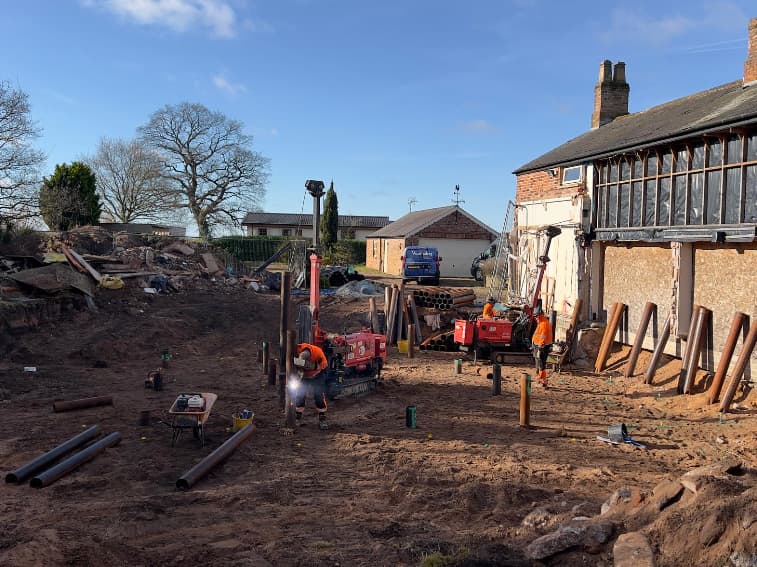
Restricted access piling allows foundation work to happen in these tight, historic settings without the disruption a larger rig would cause, and underpinning work on older timber framed buildings in particular needs to be handled with real care given how these structures were originally built.
Agricultural buildings and rural development
East Anglia remains one of the most agricultural regions in the country, and a good deal of construction work here involves farm buildings, grain stores and rural diversification projects, converting old barns into homes or holiday accommodation. These sites often sit on the same soft Fen soils discussed earlier, which makes getting the foundation design right from the outset particularly important given the scale some agricultural buildings need to support.
A flat region with hidden complexity
East Anglia doesn’t look like a difficult region to build on at first glance. No mountains, no steep valleys, nothing dramatic about the landscape. But between deep Fen peat, mixed glacial deposits, coastal erosion and a scattering of historic towns, it presents just as many genuine foundation challenges as anywhere else covered in this series. Get in touch if you’ve a project in the East of England you’d like us to take a look at.
That brings this second leg of the series to a close. From Scotland’s granite to East Anglia’s peat, the UK’s ground conditions rarely stay the same for long, which is exactly why proper investigation before work begins will always be worth the time it takes.
Bristol and the surrounding clay
Bristol sits on a mix of clay, mudstone and limestone, shaped by the Avon Gorge and the wider geology of the area. Much like London clay further east, some of the clay found around Bristol and North Somerset is reactive, meaning it shrinks and swells with the seasons and can cause real problems for shallow foundations, particularly on older properties with mature trees nearby.
Piled foundations that go past this active layer give a much steadier base to build on, and with Bristol’s popularity for renovations and extensions in recent years, it’s a job that comes up often across the city’s Victorian terraces and townhouses.
Dartmoor, Bodmin Moor and granite ground
Head further into Devon and Cornwall and the geology changes dramatically. Dartmoor and Bodmin Moor are both granite moorland, and while granite offers excellent bearing capacity once you reach it, getting there isn’t always straightforward. Weathered granite, known locally as growan or china clay in some contexts, can behave more like a loose, sandy material near the surface before giving way to solid rock further down.
Understanding exactly where that transition happens on a given site is essential, since guessing wrong can mean piles that are either too short to reach a stable bearing point or unnecessarily deep and costly. A proper site investigation matters just as much here as it did with the sandstone we discussed in the North East.
Soft coastal ground and tidal estuaries
The South West has an enormous amount of coastline, and much of it is defined by tidal estuaries, the Exe, the Tamar, the Fal, along with countless smaller creeks and harbours. Land close to these estuaries is often soft and alluvial, built up over centuries of silt deposits, and it comes with a high water table that shallow foundations simply aren’t equipped to deal with.
Piling down through this soft material to reach a genuinely stable stratum is the standard approach for anything built close to the water here, whether that’s a harbourside development in Falmouth or a riverside extension near Totnes.
Historic towns and restricted access
The South West is full of historic market towns and fishing villages, many with narrow medieval street layouts that were never designed with modern construction plant in mind. Cobbled lanes, tight courtyards and listed buildings are common in places like Totnes, St Ives and Wells, and getting standard rigs into these locations is often simply not possible.
Restricted access piling is the practical answer here. Compact equipment that can navigate narrow lanes and small courtyards makes it possible to carry out proper foundation work even in the most constrained historic settings, without causing damage to surrounding buildings or streetscapes.
Second homes and rural conversions
The South West also has a high proportion of barn conversions, holiday lets and rural extensions, particularly across Devon and Cornwall’s more remote areas. These sites often combine several of the challenges already mentioned, restricted access, uncertain ground conditions and, occasionally, granite bedrock at unpredictable depths, all on a single plot.
Domestic piling services designed around exactly this kind of project make it possible to get a stable foundation in place without the scale or disruption of a full commercial rig.
A region of contrasts
From Bristol’s reactive clay to Dartmoor’s granite, from soft tidal estuaries to the narrow lanes of a Cornish fishing village, the South West brings together a striking range of ground conditions within a relatively compact area. It’s a region where local experience really does count, since what works on one side of the moor might be entirely wrong on the other. Get in touch if you’ve a South West project you’d like us to look at.
Next time we finish this leg of the series in East Anglia, where flat fenland and a very different set of soil conditions await. That’s part eight.