

We covered the North West, the Midlands, the South and the North East in our first run through this series, and the response was good enough that we’re carrying on. First stop this time round is Scotland, a country with some of the most varied ground conditions anywhere in the UK, from soft central belt clay to solid Highland rock.
The central belt and its glacial history
Most of Scotland’s population, and a fair chunk of its construction work, sits within the central belt, running roughly from Glasgow through to Edinburgh. Like a lot of the UK, this area was shaped by glaciation, and the ground here is often a mix of glacial till, sand and clay, laid down unevenly as the ice retreated. That unevenness is the key thing. A site in Glasgow’s East End might have firm ground within a metre, while a plot a few streets over sits on soft, compressible material that needs far deeper foundations.
Add in the fact that Glasgow and Edinburgh both have long industrial histories, shipbuilding on the Clyde, brewing and printing in Edinburgh, and you get plenty of made ground scattered through the cities too. Piling through this kind of mixed and unpredictable ground, down to something genuinely load bearing, tends to be a far safer bet than guessing based on what a neighbouring plot turned up.
Peat and soft ground in rural areas
Move further out from the central belt and the ground conditions change again. Large parts of rural Scotland, particularly in the Highlands and the Southern Uplands, sit on peat or other soft organic soils. Peat is notoriously poor at bearing load. It compresses easily and can continue settling for years after a building goes up if the foundations aren’t designed with it in mind.
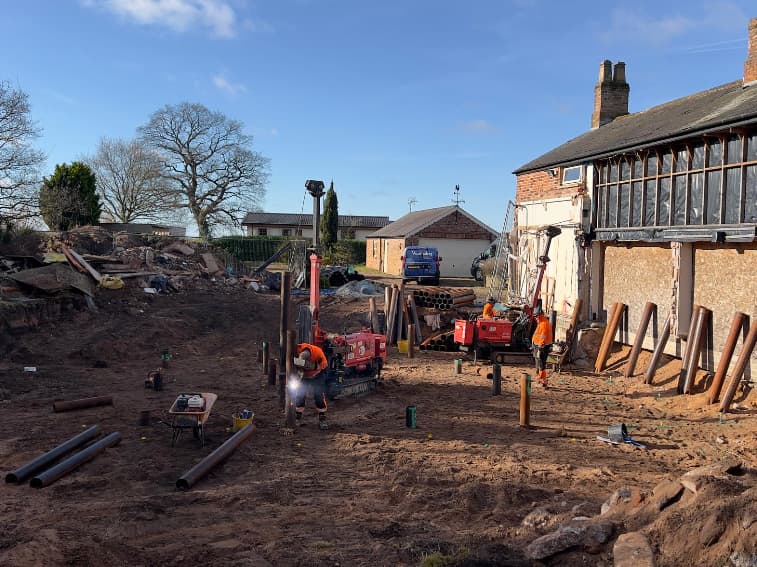
Mini piling works well here because it lets you get down through the peat layer to reach firmer ground beneath, without needing to excavate and remove huge volumes of soft material first. For rural extensions, agricultural buildings or holiday lets in these areas, it’s often the most practical way of getting a stable foundation without a disproportionate amount of groundwork.
Tenement housing and restricted access
Scotland’s cities are known for their tenement housing, tall stone built blocks that have stood for well over a century in many cases. Extending or underpinning a tenement flat brings its own set of problems. Shared stairwells, communal back courts and narrow closes mean access for standard plant is often out of the question.
Restricted access piling is built for exactly this kind of site. Compact rigs can be brought through a close or into a small back court without disturbing neighbouring properties, which matters a great deal when several households share the same building. It’s careful, considered work, and it’s usually the only realistic way to strengthen foundations on a tenement without a much larger and more disruptive undertaking.
Rock close to the surface
In contrast to the soft ground found in the peat lands, a lot of Scotland, particularly in the Highlands and parts of Aberdeenshire, has bedrock sitting close to the surface. Granite and other hard rock formations can make excavation tough going, but they also offer excellent bearing capacity once you’re through the topsoil. The challenge tends to be less about stability and more about knowing exactly how deep that rock sits before work begins, since it can vary considerably even within a single site.
Coastal and flood risk areas
Scotland’s long coastline brings its own considerations too. Towns and developments near the Firth of Clyde, the Firth of Forth or the many sea lochs dotted along the west coast often deal with soft, waterlogged ground close to sea level, along with a real risk of flooding. Piled foundations that carry a structure’s weight down past this unstable layer are usually essential here, rather than optional.
A country of extremes
From soft central belt clay to hard Highland granite, from tenement closes to rural peat, Scotland offers about as much variation as anywhere we’ve covered in this series. It’s a good reminder that ground conditions rarely respect a simple regional label, and that proper investigation before work starts matters just as much here as anywhere else. If you’ve a project north of the border, get in touch and we’ll talk you through what’s likely underfoot.
Next time we head over to Wales, where old mining valleys and coastal ground bring a different set of problems again. That’s part six.