

We’ve gone from the North West through the Midlands and down to London and the South East. For the last stop on this tour, we’re heading up to the North East, where old coalfields, sloping ground and hard sandstone bring their own set of challenges.
Coalfields old and new
Like the Midlands, much of the North East sits above old coal workings, County Durham, Northumberland, the outskirts of Newcastle, all of it part of what used to be the Great Northern Coalfield, one of the biggest in the country. Deep mining stopped decades ago, but what it left behind is still there.
Old shafts, adits, pockets of loose ground from workings that were never properly backfilled. Coal Authority searches are a decent starting point when building on former colliery land, but they don’t tell the whole story, especially with older or informal workings that predate proper record keeping. Piling down to solid, unaffected ground means you’re not relying on guesswork about what might be underneath.
Sloping and undulating sites
The North East also has a lot more variation in terrain than some of the flatter regions we’ve looked at earlier in this series. The Durham dales, the hills around Northumberland, sloping sites are common up here, and building on a slope brings problems of its own. Uneven loading, the risk of ground creep, and just getting standard plant onto an angled site in the first place.
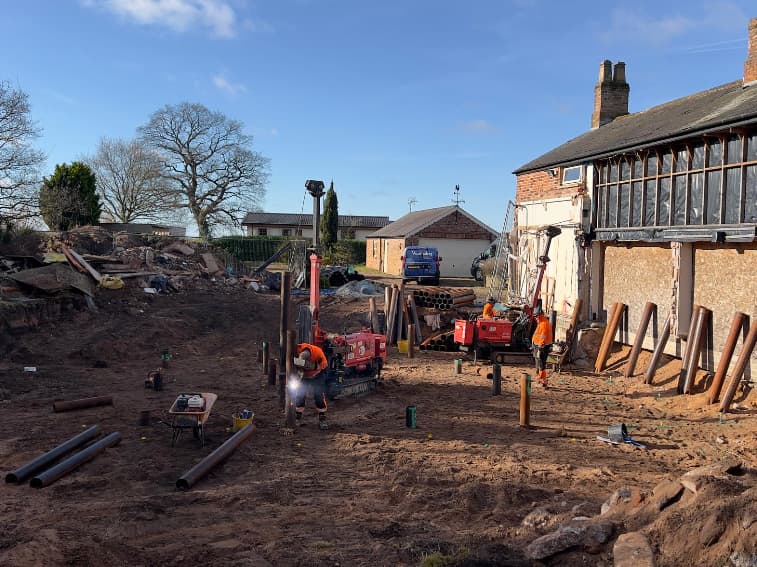
Mini piling rigs are smaller and easier to manoeuvre than traditional piling equipment, so they tend to cope better on sloping or uneven plots. You can position them more flexibly, and they don’t need the same ground preparation a larger rig would demand, which matters when levelling the site beforehand isn’t really an option.
Sandstone and harder bedrock
Where the North West and Midlands are largely clay, parts of the North East sit on harder sandstone and millstone grit, particularly further into the Pennines and around towns like Hexham. That can actually work in a builder’s favour, giving strong, stable bearing capacity once you reach it. The catch is how much the depth varies from site to site. What looks like solid rock in one test pit might be several metres deeper just a short distance away.
Getting an accurate read on where that stable layer actually sits matters a lot here. Get it wrong and you’re looking at piles that are the wrong length, or costly surprises halfway through a job.
Industrial heritage along the Tyne and Tees
Beyond mining, shipbuilding and heavy industry along the Tyne and Tees have left their own mark on riverside ground. Former shipyards, steelworks, dock land, a lot of it has been redeveloped for housing and commercial use, and what’s underneath is often a mix of demolition material, old foundations and industrial fill, not too different from the former factory sites we saw in the Midlands.
Made ground like this needs the same approach as anywhere else, sound excavation work followed by piling down to genuine load bearing strata rather than trusting the surface, particularly with so much new domestic housing now going up close to the rivers.
A fitting end to the tour
Glacial till in the North West, old mine workings in the Midlands, reactive clay in London, a sloping, coal marked landscape in the North East. This series has shown just how much ground conditions can shift across a fairly small country. There’s no one size fits all approach to foundations. Every site has its own story, and understanding that story before work begins is what separates a foundation built to last from one that causes problems years down the line.
That’s the tour done. Wherever the ground takes you next, getting the site investigation right at the start will always pay off later. Browse our areas we cover or get in touch to talk through your project.