

Every region of the UK throws up different ground conditions, which is one of the things that keeps this job interesting. Over this four part series we’re taking a tour of the country to look at what makes foundation work different from one area to the next. First up is the North West, home turf for Vxcel Piling and a region with more going on underfoot than most people would guess.
A patchwork of ground conditions
Lancashire, Greater Manchester and Merseyside sit on a mix of glacial clay, sand and gravel, left behind by ice sheets thousands of years ago. That glacial till doesn’t behave consistently. On one site it’s firm and load bearing within a metre or two. A few streets away it might be soft, waterlogged, or full of boulders the ice dragged along with it. There’s no shortcut here. A proper site visit tells you more than any assumption about “Lancashire clay” ever will.
Then there’s the industrial past. Old mill sites, former railway sidings, factories that stopped operating decades ago, all of it has left made ground scattered across the region. Someone extending a terraced house in Blackburn or Bolton might expect to dig into natural clay and instead hit rubble, ash or the footings of a building that hasn’t stood for a hundred years. It happens more often than you’d think, and it’s one of the reasons mini piling suits so many domestic extensions round here.
Terraced housing and tight access
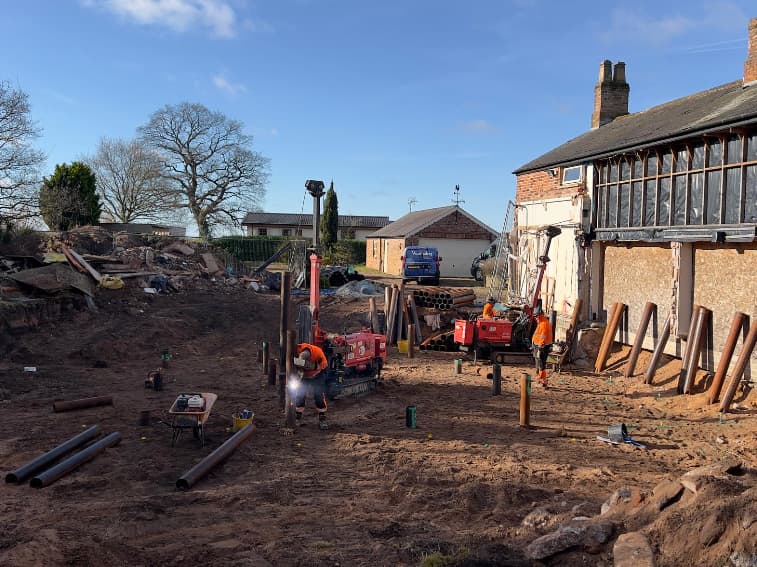
Anyone who’s worked in the North West knows the drill with terraced housing. Rows and rows of Victorian and Edwardian terraces, and a large chunk of piling work in the area is single or double storey rear extensions on exactly these properties. The problem is access. Narrow ginnels, shared boundaries, tiny back yards. A standard piling rig won’t get near it, which is exactly the kind of job restricted access piling is built for.
Mini piling rigs can. Some will fit through a gap as narrow as 750mm without anyone needing to pull down a fence or knock a hole in a wall. For a family adding a kitchen extension in Bury, or a small office extension in Preston, that’s often the difference between the job going ahead and it stalling before it starts.
River valleys and flood plains
Geography plays its part too. The Ribble, the Mersey, the Irwell and plenty of smaller rivers cut through the North West, and land near them tends to sit on soft alluvial deposits with a high water table. Build close to a flood plain around Lytham, or along stretches of the Ribble Valley, and you need foundations that go well past the unstable surface layers before they hit anything solid.
Piled foundations do exactly that. They carry the weight of a structure down to a stronger layer, bypassing the soft, wet ground near the top. Skip that step and a conventional strip foundation could be settling and cracking within a few years.
Subsidence and clay shrinkage
Clay across parts of Greater Manchester and Cheshire shrinks and swells with the seasons, and it’s worse near mature trees. Dry summers pull the moisture out and the clay contracts. Wet winters put it back and the clay swells again. Do that year after year and older properties on shallow foundations start to crack.
Underpinning with mini piles is the usual fix. It gives the building a deeper footing that doesn’t move with the surface clay. It’s slow, careful work, often carried out around people still living in the house, but it can add years of stability to a home that would otherwise keep cracking every couple of summers.
A region that keeps you on your toes
Glacial till, Victorian terraces, flood plains, shrinking clay. The North West covers about as much variety as you’ll find anywhere in the UK, and that’s a large part of why experience counts for so much in this trade. Knowing what’s likely under a Bolton back garden versus a Ribble Valley plot isn’t something you get from a manual. It comes from years of digging, testing and adjusting on site. Take a look at some of our recent North West projects to see it in practice, or get in touch if you’ve got a site you’d like us to look at.
Next time we head down to the Midlands, where old mine workings and heavy clay belts bring a very different set of problems. That’s part two.